Home

portable EV charger

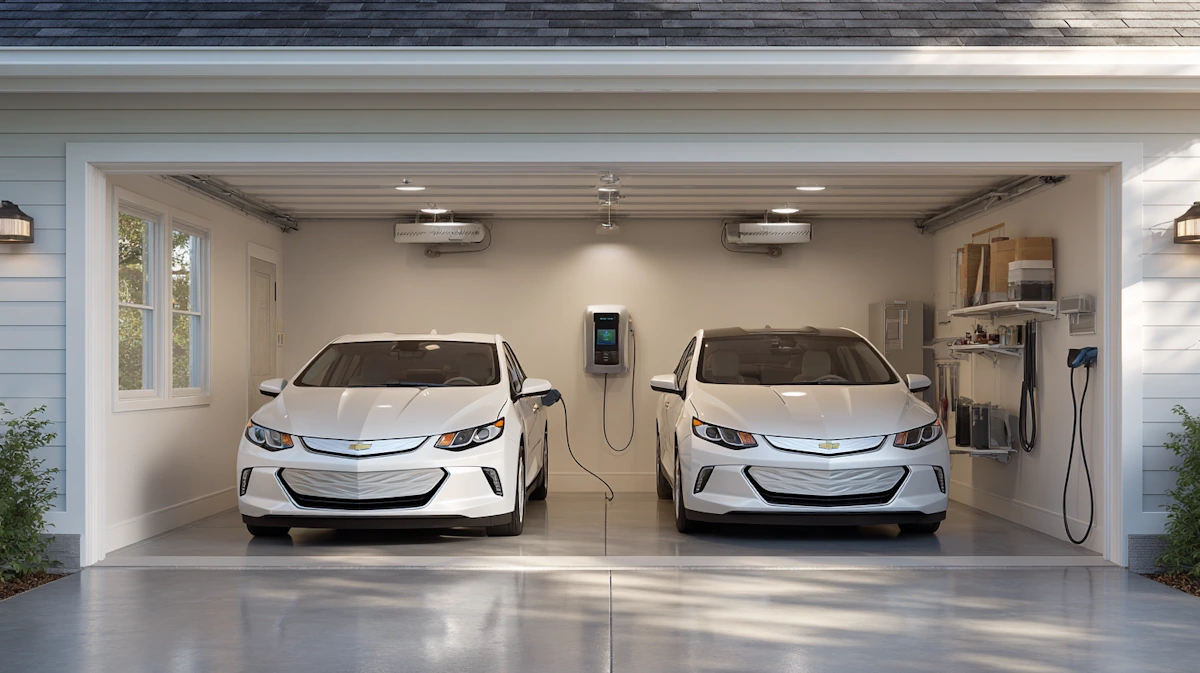
  • Two EVs at Home: One Charger or Two? Two EVs at Home: One Charger or Two?
    Nov 18, 2025
    Most households don’t need two wall chargers. The right setup depends on five things: daily miles for each car, how much evening time overlaps, spare panel capacity, whether you use time-of-use pricing or solar, and how much cable swapping you can accept.     Decision ChecklistScore each item 0–2 (0 = low pressure, 2 = high). Add them up. Factor 0 1 2 Daily miles per car < 25 mi 25–60 mi > 60 mi Evening overlap Rare Sometimes Most nights Spare panel capacity ≥ 60 A available 40–50 A < 40 A TOU/solar window Not using Nice to have Must finish both in cheap window Willingness to rotate Happy to rotate Can rotate weekly Prefer set-and-forget     Result guide:0–3 one Level 2 with rotation; 4–6 dual-port or load-sharing on one circuit; 7–10 two dedicated Level 2 circuits. Quick Math• Energy needed (kWh) ≈ daily miles × 0.30• Charge time (hours) ≈ energy needed ÷ 7.2 kW (typical 40 A @ 240 V L2)   Examples• 35 mi/day → ~10.5 kWh → ~1.5 h. Two cars can rotate easily overnight.• 70 mi/day → ~21 kWh → ~3 h. Two cars may benefit from dual-port/load-sharing or two circuits to finish within a short off-peak window.     Charging Options for Two EVs A) One Level 2, rotate by scheduleWhen it fits: moderate miles, staggered arrivals, or anyone okay moving a plug once.Pros: low cost; often no panel upgrade; simple to maintain.Trade-offs: needs a routine; late arrivals may wake up partially charged.   B) Dual-port or load-sharing on one circuitWhen it fits: limited panel capacity; both cars home at night; you want automation.Behavior: two connectors share one feeder; current splits between cars while both are charging; when one tapers or finishes, the other ramps up.Pros: set-and-forget; often avoids panel work.Trade-offs: peak rate per car is lower when both charge.   C) Two dedicated Level 2 circuitsWhen it fits: high miles on both cars; tight morning deadlines; short off-peak windows.Pros: fastest and most independent; easier to expand later.Trade-offs: highest install cost; possible panel upgrade.      Option Comparison Criterion Rotate One L2 Dual-Port / Load-Sharing Two Dedicated L2s Up-front cost Low Medium High Ready by morning (both cars) Medium Medium–High High Panel impact Minimal Minimal–Moderate Moderate–High Convenience Moderate High Very High Expandability Low Medium High Install complexity Low Medium High       Cost and Install Factors Factor Low impact Medium impact High impact Run length panel→charger ≤ 10 m 10–25 m > 25 m Walls and routing Same-wall, single pass One turn, short surface conduit Multiple turns, attic/crawlspace work Indoor/outdoor Indoor, dry Semi-covered carport Fully outdoor, weatherproofing and trenching Spare circuits Empty slot available Subpanel needed Main service upgrade likely Parking layout Two cars nose-to-nose, short leads Staggered bays, longer cable management Separate bays, long conduit or second location     Electrical Capacity and CircuitsSpare capacity is how much continuous current your panel can safely add. Many homes can support one 40 A circuit for a Level 2 unit without upgrades. A second circuit may require a load calculation and, in some homes, a panel or service upgrade. Load-sharing products let two connectors live on one feeder and coordinate current as cars start and stop.     Single-Phase RealityYou don’t need three-phase to charge two cars. On single-phase, sharing splits available power; the right metric is whether each car reaches its target by departure time, not its peak kW at any instant.     When Two Chargers Make Sense• Both cars often exceed about 50–60 miles per day.• Evenings overlap and both must finish before early departures.• Off-peak tariff windows are short and you want two cars to complete within them.• Winter range loss or frequent road trips compress your overnight buffer.• You plan for growth: another EV, visitors, or faster onboard chargers.     When One Charger Is Enough• Typical days are under 40 miles per car.• Arrivals are staggered; one car sits most nights.• You can rotate once in the evening or a few times per week.• A 120 V cord covers occasional top-ups.• You prefer to defer panel upgrades.     Implementation Options• Dual-port EVSE on one circuit: two connectors, coordinated split, simple user experience.• Two same-brand units with cloud load-sharing: devices balance current on the same feeder.• Two independent circuits: clean performance for high-mileage pairs or tight schedules.Tip for flexible nights: in rotation scenarios, a Workersbee portable EV charger helps with temporary or overflow charging without changing fixed wiring.     TOU and Solar: Finish Both in the Cheap Window• Start both sessions near the off-peak opening.• Prioritize the early-departure car with a higher target or earlier start.• Expect slower rates while both are charging; once the first tapers or completes, the second ramps.• With rooftop solar, combine daytime charging for one car and overnight for the other to improve self-consumption.For fixed installations that see daily use, durable Workersbee EV connectors pair well with scheduled charging and load-sharing strategies.     Safety, Permits, and Installation• Confirm permit and inspection needs before work.• Match conductor size and breaker rating; respect continuous-load limits.• Use weather-appropriate enclosures and fittings outdoors; add drip loops.• Keep cables off walkways; add hooks or rests; avoid tight bends.• Label circuits and parking spots so rotation stays simple and safe.     FAQCan two EVs share one charger effectively?Yes, if miles are moderate or you can schedule. Load-sharing or dual-port hardware reduces hassle.   Do I need three-phase to charge two cars at once?No. Single-phase can support two cars with sharing or two circuits. Peak speed per car is lower than a single dedicated circuit.   Is a second charger worth it with TOU or solar?If your cheap window is short or you aim to maximize self-consumption, two connectors help both cars finish on time.   Panel capacity seems tight—what is the first step?Get an on-site load calculation and route assessment, then weigh sharing on one feeder versus a service upgrade.
    Read More
  • What Is EV Range? A Simple Guide for Everyday Drivers What Is EV Range? A Simple Guide for Everyday Drivers
    Oct 30, 2025
    EV range is the distance an electric vehicle can travel on a full charge under a defined test cycle. It’s a benchmark, not a promise. Real driving shifts the number up or down with temperature, speed, terrain, wind, and how you use heating or A/C.     Why lab numbers differ from daily drivingTest labs fix temperature and driving patterns. Your commute doesn’t. Cars also spend energy warming or cooling the battery to protect it. At higher speeds, air drag grows quickly, and headwinds behave like driving faster. That is why the sticker is a starting point, not your guaranteed outcome.     How Range Is Measured (EPA, WLTP, Road Tests) EPA mixed-cycle basicsIn the U.S., the EPA combines simulated city and highway driving into one rating. The cycle includes cold starts, stops, and steady cruises, then applies adjustments so the result reflects typical use. You see one number on the window label to keep things simple.   WLTP regional differencesWLTP is common in Europe and many export markets. It uses a different speed profile and temperature window, usually producing a higher figure than EPA for the same car. Numbers are comparable within one region’s system, but not always apples to apples across systems.   Why media tests and owner reports varyMany outlets run a steady 70–75 mph highway loop; owners drive mixed routes at mixed temperatures. Both can be valid, but they answer different questions. Highway-only tests reflect road trips; mixed cycles reflect everyday use.     What Changes Your Actual Range Temperature and battery conditioningBatteries are happiest in mild weather. In the cold, the pack is less efficient and the cabin needs heat. Preconditioning while plugged in—warming the pack and cabin before you depart—can recover a lot of winter loss. In extreme heat, the system may cool the pack to protect longevity.   Speed and driving styleEnergy use climbs sharply with speed. A steady 65–70 mph cruise is usually better than running at 80 mph or repeatedly accelerating hard. Smooth inputs, anticipation, and coasting into traffic lights help more than any single gadget.   HVAC loadsHeat is the big penalty in winter, especially with resistive heaters. A/C in summer costs something, but usually less than heat in freezing weather. Seat and wheel heaters keep you comfortable with relatively little draw.   Terrain, wind, and elevationLong climbs spend energy; descents return some through regeneration, but not all. Headwinds and crosswinds add drag. Route choice matters: a slightly slower but flatter road can beat a shorter, steeper one.   Tires, racks, and weightUnder-inflated tires, all-terrain tread, bigger wheels, roof boxes, and bike racks all increase drag or rolling resistance. Keep tires at the recommended pressure and remove racks when not in use. Extra cargo weight hurts range, especially in hilly areas.   Software and eco modesEco profiles temper throttle, optimize HVAC, and can schedule battery conditioning before a DC fast charge. Over-the-air updates sometimes bring efficiency tweaks—worth keeping current.     One-screen adjustment tableStart with your rated range (EPA or WLTP). Multiply by the scenario factor to get a practical planning number. Use the low end of the range for cautious planning, the high end if you know your route and conditions well.   Ambient temperature Driving pattern HVAC use Scenario factor 15–25 °C (59–77 °F) Mixed city/highway Light A/C 0.95–1.00 15–25 °C (59–77 °F) 70–75 mph highway A/C off or light 0.85–0.92 >30 °C (>86 °F) Urban stop-and-go A/C medium 0.90–0.95 >30 °C (>86 °F) 70–75 mph highway A/C medium 0.82–0.90 0–10 °C (32–50 °F) Mixed Heat low 0.80–0.90 <0 °C (<32 °F) Mixed Heat medium 0.70–0.85 <0 °C (<32 °F) 70–75 mph highway Heat medium/high 0.60–0.80   Two quick examplesWinter commute: Rated 400 km. Morning is −5 °C with heat on, mixed roads. Apply 0.75. Planning range ≈ 300 km.Summer highway: Rated 300 miles. Afternoon 32 °C, steady 72 mph with moderate A/C. Apply 0.86. Planning range ≈ 258 miles.     BEV vs PHEV: What Electric Range Means Electric-only vs total rangeA battery-electric vehicle (BEV) lists a single all-electric range. A plug-in hybrid (PHEV) lists electric-only miles; after that, it runs as a hybrid on liquid fuel. If your days are short hops and you rarely exceed the electric-only distance, a PHEV may fit. If you prefer one energy system and have regular access to charging, a BEV keeps it simpler.   When each makes senseChoose a PHEV if charging is intermittent and your daily distance is modest. Choose a BEV if you can charge at home or work and want the smoothest electric drive every day. For fleets, think about route repeatability and depot charging windows.     Range Over Time Battery health and agingCapacity declines gradually with age and cycles. The pattern is often a small early drop, then a slower long glide. Avoid sitting at 0% or 100% for extended periods. At home, keeping the car plugged in lets thermal management work and prevents deep swings.   Seasonal swingsIt’s normal to see 10–30% swings between winter and summer in colder climates. Don’t chase day-to-day changes on the in-car estimate; judge trends over weeks and across similar conditions.     Simple habits that helpPrecondition when plugged in. Maintain tire pressure. Remove roof loads when not needed. Drive smoothly and pick steady speeds. These basics deliver most of the gain without micromanaging.     FAQ Why does range drop so much in winter?Cold chemistry and cabin heat both add load. Preheat while plugged in and use seat heaters to cut the penalty.   Why is highway range sometimes lower than city?At steady high speed, aerodynamic drag dominates. In city driving, regeneration recovers energy from braking; the gap can narrow or even reverse.   How much do A/C and heat matter?A/C tends to be a light to moderate hit. Heat in freezing conditions can be significant. Heat pumps help, but they are not magic at very low temperatures.   Do bigger wheels or all-terrain tires matter?Yes. Heavier, wider, or knobbier setups increase rolling resistance and drag. Expect a few to several percent depending on the change.   Can I trust the in-car range estimate?Treat it as a guide based on recent driving and current conditions. For trips, use the scenario table, map elevation, and weather to plan with a buffer.     If you’re planning a range with buffers and smart stop choices, it also helps to make home and on-the-go charging simple. For apartments, rentals, road trips, or as a winter backup, a portable EV charger with adjustable amperage and interchangeable plugs lets you charge from common outlets without installing a wallbox.   In Europe and many export markets, our Type 2 portable EV charger series focuses on safe thermal design, clear status feedback, and tough strain-relief for daily use. Tell us your plug types and typical circuits—we’ll suggest a portable setup that fits your car and routines.
    Read More

  • How to Choose a Portable EV Charger: Your 2025 Guide to Never Running Out of Juice How to Choose a Portable EV Charger: Your 2025 Guide to Never Running Out of Juice

    Feb 20, 2025
    So, you’ve joined the electric vehicle (EV) revolution—congrats!  But let’s be real: even the coolest Tesla or futuristic Rivian won’t save you from that mini heart attack when your battery icon turns red and the nearest charging station is… checks map… 50 miles away. That’s where a portable EV charger swoops in like a superhero. But how do you pick the right one? Don’t panic—we’ve got your back.     In this guide, we’ll break down everything you need to know about choosing a portable EV charger that fits your lifestyle, budget, and EV model. Whether you’re planning a cross-country road trip, a weekend camping adventure, or just want peace of mind for daily commutes, let’s plug into the details.       Why You Need a Portable EV Charger (Spoiler: It’s Not Just for Emergencies)   Before we dive into specs and features, let’s talk about why a portable EV charger is a must-have:   - Emergency Backup: Dead battery? No problem.   - Travel Flexibility: Charge anywhere with a standard outlet—hello, Airbnb stays and remote cabins!   - Future-Proofing: Public charging networks aren’t perfect (yet). A portable charger keeps you independent.   - Cost Savings: Skip the markup at some public stations by charging at home or friends’ places.     But not all portable chargers are created equal. Let’s avoid the “oops, this doesn’t work with my car” moment.     Step 1: Check Compatibility—Does It Play Nice with Your EV?   Imagine buying a charger only to realize it’s like trying to fit a USB-C cable into an iPhone 15. Yikes. Here’s how to dodge that:     A. Connector Types: Know Your Port Most EVs in North America use either:   - J1772 or IEC 62196 : The standard plug for Level 1 and Level 2 charging (used by Tesla with an adapter).   - Tesla Connector: Native to Tesla vehicles.     Pro Tip: If you drive a Tesla, ensure the charger includes a Tesla-compatible plug or a reliable adapter.     B. Voltage & Charging Speed: Level Up Portable chargers typically fall into two categories:   - Level 1 (120V): Plugs into a standard household outlet. Slow but universal—adds ~3-5 miles of range per hour.   - Level 2 (240V): Requires a dryer/RV-style outlet. Faster, adding ~12-30 miles per hour.     Ask yourself: Do I need speed or convenience? Level 1 is great for emergencies and casual use; Level 2 is better for frequent travelers or those with longer commutes.     C. Vehicle Compatibility Double-check your EV’s manual for:   - Maximum accepted charging power (e.g., 32A, 40A).   - Any brand-specific requirements (e.g., Tesla’s unique voltage needs).     Step 2: Prioritize Safety—Because “Battery Fire” Isn’t on Your Bucket List   A cheap, uncertified charger might save you $100 today… and cost you $10,000 tomorrow. Safety features are non-negotiable:     - UL Certification: Look for chargers certified by Underwriters Laboratories (UL) or ETL. Avoid no-name brands from sketchy websites.   - Overcurrent/Overvoltage Protection: Prevents damage from power surges.   - Weather Resistance: If you’ll charge outdoors, aim for IP65 or IP67 ratings (dustproof and water-resistant).   - Temperature Monitoring: Automatically stops charging if things get too hot.     ⚠️ Red Flag: If a charger feels flimsy or lacks safety certifications, swipe left.     Step 3: Portability—Because Nobody Wants to Lug Around a Boat Anchor   A “portable” charger shouldn’t require its own suitcase. Consider:     - Weight: Aim for under 10 lbs. Heavy-duty models might hit 15-20 lbs.   - Cable Length: 15-25 feet is ideal for reaching outlets in awkward parking spots.   - Storage Design: Coiled cables, carrying cases, or compact shapes make storage easier.     Step 4: Charging Speed vs. Power Source—What’s Your Lifestyle?   Your charging needs depend on how you use your EV:     - Urban Commuters: Level 1 may suffice for topping up overnight.   - Road Trippers: Level 2 cuts charging time in half (e.g., 8 hours vs. 16 hours for a full charge).   - Adventure Seekers: Look for dual-voltage chargers (120V/240V) to adapt to RV parks or campsites.     Example: Workersbee’s Flex charger 240V charges a Rivian from 0-80% in ~6 hours at 240V—perfect for a weekend getaway.     Step 5: Smart Features—Nice-to-Haves vs. Essentials   Modern chargers come with bells and whistles, but which matter?     - Wi-Fi/App Connectivity: Monitor charging remotely, schedule sessions, or track energy use. Handy, but not essential.   - Adjustable Amperage: Customize charging speed to avoid tripping circuit breakers.   - LCD Screen: Displays real-time stats like voltage and charging time.     Keep It Simple: If you’re tech-phobic, skip the app and opt for a plug-and-play model.     Step 6: Warranty & Support—Because Stuff Happens   A 2-3 year warranty is standard. Look for brands that offer:   - Responsive customer service (24/7 chat or phone support).   - Replacement policies for damaged cables or connectors.     Workersbee, for example, covers all chargers with a 2-year warranty and free troubleshooting guides.         Final Checklist Before You Buy   - ☑️ Compatible with your EV’s connector and voltage.   - ☑️ Safety certifications (UL/ETL/TUV).   - ☑️ Portable enough for your needs.   - ☑️ Warranty of at least 2 years.   - ☑️ Reviews that don’t scream “THIS MELTED MY OUTLET!”     Wrap-Up: Stay Charge, Stay Connected   Choosing a portable EV charger isn’t rocket science, but it requires some homework. Prioritize compatibility, safety, and daily needs—whether that’s lightning-fast charging or a lightweight design for adventures.        Ready to never worry about empty batteries again? Your future self (stuck in that scenic mountain town with an outlet and a latte) will thank you.      
    Read More
  • EV Charging methods, characteristics and investment direction of new energy vehicles
    Mar 08, 2023
    This article WORKERSBEE will explain common new energy vehicle charging methods, advantages and disadvantages, and market demand. Portable ev charging: Portable charging refers to using the portable charging cable attached to the car to connect to an ordinary household socket for charging. This method is very convenient, as long as you can find a power source and an outlet. Portable ev charger is a relatively safe charging method, with good waterproof and dustproof effects, low heat generation, and strong flame retardancy. WORKERSBEE latest design with temperature control system. The appearance is fashionable and the lines are simple. No matter what model it is with, there is no sense of disobedience when matching it with car decorations and clothing. Portable ev chargers are very popular in countries with developed tourist industries. It can not only become a must-have item for self-driving tours, but also a supplementary device for other electric car charging methods. A portable ev charging system can help you realize the freedom of safe electric car charging.   Home charging: Home charging station are a very common type of charging station. The home charging station is a charging device that provides DC/AC power for new energy electric vehicles. The function of the charging pile is similar to that of a fuel dispenser in a gas station. Its input end is connected to the AC power grid, and its output end charges the battery of an electric vehicle through a charging plug. Charging piles are installed in public buildings (public buildings, shopping malls, public parking lots, etc.), residential parking lots, and private houses, and can be fixed on the ground or walls. Public charging: Public electric vehicle charging piles adopt a collective shared charging model, and are generally built in urban streets, office buildings, public parking lots, high-speed service stations and other places, which can meet the charging needs of new energy vehicle owners in different scenarios. Public charging is generally built in places with convenient transportation and dense crowds.  To sum up, new energy vehicles are the future development trend, and new energy vehicles may also become one of the main means of transportation for people in the future. Therefore, the construction of charging piles is further accelerating, and the sales of household charging piles and Portable ev chargers are steadily increasing. Consolidate the development path of new energy vehicles and improve the experience of new energy vehicle owners.
    Read More
  • How to start charging with a portable EV charger?
    Nov 02, 2021
    1. Firmly insert the power plug into the power outlet socket (e.g. wall socket). Ensure the outlet socket has a Max charging current of no more than 32A. Short press the switch to select among 10A, 16A, 20A, 24A, and 32A before inserting the charging plug into the EV socket. 2. Press the 2nd button on the control box to appoint the time to start charging. Each press of the 2nd button means charging in 1 hour. The user can set charging to begin in 12 hours by pressing the 2nd button 12 times. 3. Insert the EV connector into the inlet on the electric vehicle. Then you can short press the switch to check the charging time. 4. The device starts charging automatically after the green LED light begins to keep    
    Read More

Need Help? leave a message

Leave A Message
Submit

home

products

whatsApp

contact